Sunday, 5 June 2016

Week Four Historical Context

WEEK 4 - THEATRES, ACTORS AND ACTING IN SHAKESPEARE’S TIME

QUESTION: Who were the actors of Shakespeare’s plays and how did the experience of being an actor differ from the experience today?

During the period in which shakespeare was alive, known as the elizabethean period there were only two type of playhouses.  There were outdoor playhouses, also known as ‘amphitheatres’ or ‘public’ playhouses, and indoor playhouses, also known as ‘halls’ or ‘private’ playhouses. As both were so different they attracted different audiences because of it.


  All of the outdoor playhouses were built in the exact same way as they all had the following properties:


  • A central yard that had no roof and was exposed to the sky
  • A raised stage sticking out into the yard and very close to the audience members
  • A roof over the stage which was commonly referred to as 'the heavens'
  • Seating all around the yard, on several levels, which was roofed and also cost more than he standing in the yard did
  • A house behind the stage that was used as an almost waiting area for actors and also a changing room


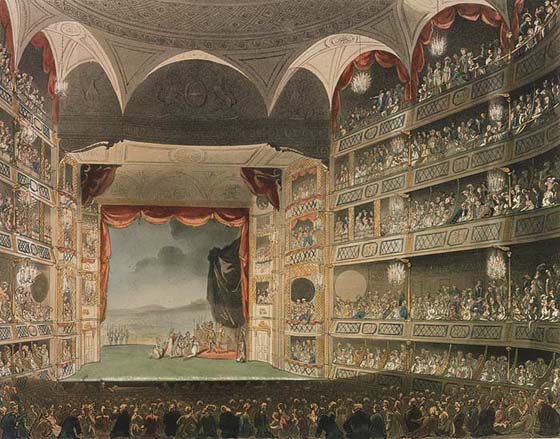
Indoor playhouses however were slightly different as they consisted of a rectangular shaped inside room with the stage along one of the short sides of the room. The audience sat, either immediately in front of the stage where the seats were most expensive, or in galleries which ran around the other three sides of the room. These playhouses were lit by candles or torches back then. Both types of playhouses were heavily decorated and with bright lights and consisted of two doors fro entrances and exits.


During the Shakespearean times it was a lot harder to stage things as there were no microphones or props so that would have to be taken into consideration.


In Shakespeare’s time acting was a profession only open to boys and men. Women were acting elsewhere in Europe but they were not allowed to perform in public theatres in England until 1660. In an Elizabethan production boys would play the female parts, like Ophelia in Hamlet or Desdemona in Othello, whilst occasionally men would play the older women.


Acting during the Shakespearean times is different to the way we would act now and  not only that but another way it is different is the process. This is because during this time the only actors would be male and this is obviously a huge change from common actors and actresses as women are of couscous allowed to act. In terms of the process it is different because the script each actor would be given would only contain their lines and their cues unlike in modern day and age when each actor is given the full script to help the play flow more seamlessly. Furthermore during those days actors were expected to not only know how to learn lines fast but also be able to sword fight, sing and dance which is not a requirement of actors of our day and age - it is interesting to compare and contrast the differences between now and then however one similarity is that they were just as actors who act in theatres are now underpaid.

Tuesday, 12 April 2016

Week Three Historical Context

What was London like in Elizabethan 

times and who were the people  

attending the theatre?


During the elizabethan era London was the richest and the biggest city in the United Kingdom it was the home of the first permanentand professional theatres in the United Kingdom during this time. Wealthy traders and manufacturers – and their workers – lived in London and becase of their employment and standard oof living and also because (as previously mentioned) that London was rapidly changing at these times they had the money to go to the theatre and these were the people found in the audience at the time.

The reason that London was rapidly growing not only econmocally but also in terms of the population is because migrants from the countryside and from Europe were migrating there. Between 1550 and 1600 it is estimated the city grew fromaround 50,000 residents to over 200,000 which means that more jobs were being created and more money was being made.  London was a bustling, overcrowded city at this time and was commonly described as 'plagued' and 'dark and narrow' which meant that criminals were also attracted to the city and diseases spreaded quickerdue to the crowds. It is reported that 10'000 people were killed in the summer 1593 and this means that the theatres were forced to close to prevent the increase of diseases.


Generally m ore men than women came to theatres in London during this time as it was the main source of entertainment as things such as phones and tvs had not been invented by then. It was said however that the theatre was the place to be whether you were extremely wealthy or less economically fortunate, it was said that servants and apprentices spent all their time there. Even royalty loved watching a play. They didn’t go to public theatres, but companies of actors were summoned to perform at the courts of Elizabeth I and James I.

https://chelseagoestochelsea.files.wordpress.com/2013/07/photo-jul-10-9-09-54-pm.jpg

Friday, 8 April 2016

Week Two Historical Context

Who was shakespeare?
Where was he born
What was that place like at that time. (size of village, habitants, what surrounded it)
Who was his family. (Parents, Brothers, Sisters)
What were his relationships
What were they like (with is family, children, women, men)
What was his proffesional life like.

The folger shakespeare library website (discover shakespeare tab)
William shakespeare facts on the globe website

Shakespeare is an English poet and writer and is considered as one of the bests of all time. He wasborn around  April 23, 1564 but as their are no actual birth records we cannot be sure. He was born in a town 103 miles west of London called Stratford-upon-Avon ad baptised in a local Holy Trinity church on the 26th of his Birth month.


 Stratford upon avon was a small town country town when William lived their and boasted a weekly market. The main market cross, the medieval High Cross, stood at the junction of Stratford High Street and Bridge Street in the centre of the town. The Elizabethan market town of Stratford-on-Avon consisted of half - timbered buildings and was situated in rural England and surrounded by countryside and woodlands.  Stratford upon Avon had about 1,500 inhabitants  but grew during the Elizabethan era as times changed.
William was the third child of John Shakespeare, a leather merchant, and Mary Arden, a local landed heiress. William had two older sisters, Joan and Judith, and three younger brothers, Gilbert, Richard and Edmund. Before William's birth, his father became a successful merchant and held official positions as alderman and bailiff, an office resembling a mayor. He married a young woman names Anne Hathaway at the age of 18 on  November 28, 1582, in Worcester, in Canterbury Province. Hathaway was from Shottery, a small village a mile west of Stratford. Their first child, a daughter they named Susanna, was born on May 26, 1583. Two years later, on February 2, 1585, twins Hamnet and Judith were born. Hamnet later died of unknown causes at age 11. Therefore it is shown that this man had many obligations as not only was he a brother and providing son he was also a husband and a father from a young age of 19. 

In terms of the professional life of William Shakespeare he was ve successful, even more so after he passed awayBy 1597, 15 of the 37 plays written by William Shakespeare were published. Civil records show that at this time he purchased the second largest house in Stratford, called New House, for his family. It was a four-day ride by horse from Stratford to London, so it is believed that Shakespeare spent most of his time in the city writing and acting and came home once a year during the 40-day Lenten period, when the theatres were closed.
By 1599, William Shakespeare and his business partners built their own theatre on the south bank of the Thames River, which they called the Globe, and a replica is sill standing today lit by only candlelights. 

In 1605, Shakespeare purchased leases of real estate near Stratford for 440 pounds, which doubled in value and earned him 60 pounds a year. This made him an entrepreneur as well as an artist, and scholars believe these investments gave him the time to write his plays uninterrupted.

Tradition has it that William Shakespeare died on his birthday, April 23, 1616, though many believe this is a myth.


Week One Historical Context

What sense do you get of what life was like in Elizabethan 

England? Try to include information on: 

The population, entertainment, religion, superstition, money, jobs, 

medicine, theatre.


Life in the Elizabethan times was not like what we are currently used to in terms of standard of living for many different reasons. One way this was different was in terms of medicine as at this time the people were extremely ignorant about germs due to the fact that there weren't many studies done on the fact.They thought of bad smells as the only ways for diseases to spread. So, they only resolved such sanitary and health issues by getting rid of the foul smell thinking that his solved the problem when it did not. Small garlands of flowers, herbs, and other sweet fragrances were usually carried by women to fight this off. This makes me feel as though life would be hard as they were not aware of medicines and so things that are easily treatable would be seen as life threatening.


Another reason as to why I get the sense that life during this time was a lot harder was due to some of their superstitions and/or the belief that the shared at this time, some of the most recognizable are as follows:


  • It was believed that when you open your mouth to sneeze, you give the devil a chance to enter your body and bring about spiritual harm. Saying "bless you" allegedly stops the devils from entering since they thought that no demon could stay in a place that a Christian has blessed.
  • Balance was considered a great deal in the Elizabethan era. They saw that the evil and good should balance each other. During the plague, they walked around with sweet-smelling flowers in their pockets and burned scented firewood to drive out the disease
  • It was also believed that if you touched a man about to be executed, if a cow breathed on you or if you spit into a fire, then you will have good luck.


I think that this amount of beliefs and superstitions left people feeling a sense of paranoia and also to a modern day audience and also left them living with a sense of fear, this is because as a lot of their beliefs relate to their religion and the devil and such it means they would always be living in fear of what they do and not really living free. I find it very interesting how the devil is thought of as a continuous presence during this time and the power that it had over the way people lived back then. This links nicely into how the lives of people back then were effected by religion and how this along with their superstitions almost made living feel like a cage. This is because religion was mandatory and what I mean by this is the practice of religion had to be supported b all as Queen Elizabeth made attending the church of England law even if some people which they did lived far, and the people who were unable to go - unless ill were punished with fines.


Overall I get the senses that life in the Elizabethan times were not easy at all and this is not only because of thins like how hard it was to get a job or their lack of medicines and things like that but also their state of mind and the fear they carried around with them on a daily basis  - which in some ways is similar to the way society lives now, fearing and attacking the unknown e.g. witch in that time due to pure naivety and ignorance.